

How Much Heat Comes Through Windows
• A typical firm loses ten% of its rut through the windows.
• The successful specification of energy efficient windows requires a audio understanding of the dynamics of thermal operation.
• Overall energy remainder = solar heat gain – estrus loss
Heat loss
Windows lose heat in a number of ways:
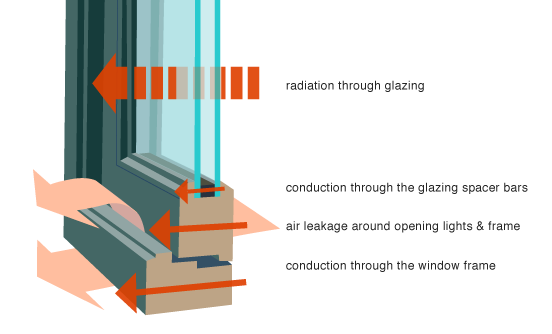
• Around 2/3 of the energy lost from a standard window is through radiations through the glazing. The inside pane of a double-glazed unit absorbs oestrus from the room and transmits it through conduction and convection (see below) to the cooler outside pane, and and so to the outside. The thermal transmittance of a glazing unit, known as the U-value, is expressed in units of Watts per square metre per degree of temperature divergence (Westward/yard2C)
• A pocket-size corporeality of rut is lost through convection inside the glazing cavity. In some circumstances, particularly in wider glazing cavities, air inside the cavity is warmed by the inner pane. The warm air rises and is replaced by cooler air and so sets up a convection current which transfers heat from the inner pane through to the outer pane(s). Convection up to 20mm in double-glazing units particularly with argon gas, which is denser than air, is insignificant; In triple glazing there is an improved performance up to between 18-20mm.
• Heat is conducted through the window frame. The rate of conduction (U-value) is governed by the frame textile – in general, timber frames perform meliorate than metallic in this respect.
• The panes in double glazing are separated and sealed at their perimeter by spacer confined. Usually fabricated from aluminium, they represent a small but not insignificant conduction road.
• After radiation, air leakage is probably the biggest correspondent to heat loss from existing windows, peculiarly in older or desperately installed windows. In an era when small gaps in the fabric were relied on equally a form of background ventilation, air leakage wasn't recognised as being the issue that it has get today. Stock-still windows lose less rut and larger windows tend to leak less air per unit of measurement area.
The kind of opening method also determines air leakage – traditional sash windows perform the worst whereas elementary casements are by and large amend. Leakage is also mutual around the frame. A combination of pre-made frames and ill prepared wall openings on site take led to a significant number of badly fitted windows with gaps left over (oftentimes big enough to be filled with newspaper).
Heat gain
Though the general balance in the UK is for windows to lose rut, they also, to a varying degree absorb heat and in some instances of high performance windows, there can exist a cyberspace gain.

Heat is captivated through glazing in 2 ways:
• Solar gain directly transmitted (main transmittance) through the glazing and
• Energy absorbed by the glazing and after transferred in past convection and radiations (secondary transmittance).
Factors effecting estrus gain
Glazing technology and the 'Yard-Value'
The 'Thou-Value' measures the degree to which glazing blocks oestrus from sunlight. The Chiliad-value is the fraction of the oestrus from the sunday that enters through a window. G-value is expressed as a number between 0 and i. The lower a glazing's G-value, the less solar oestrus it transmits.
A window'due south 1000-value is adamant by the type of glass, or combination of types, that make up the glazing unit. (come across glazing types beneath)
In most domestic situations the specification of glazing concentrates on admitting solar energy whilst preventing energy from beingness re-radiated from inside.
(The US equivalent of 'G-value' is the Solar Estrus Gain Coefficient – it differs from the European G-value in using a dissimilar value for air mass)
Orientation
In the Great britain solar free energy is gained through southerly facing windows. Tiptop assimilation for windows facing directly to the south will be during the summertime months; Likewise East and Due west facing windows will feel maximum estrus gain in the mornings and afternoons respectively during the summer.
Shading
Shading the window areas during the summer months is usually desirable. Whilst relatively easy to achieve with south facing glazing, the lower bending of the dominicus makes east and w facing windows more problematic. In these instances, shading might be possible using part of the building fabric (eg eaves or proprietary shading devices) merely an alternative might be to look at the potential of mural features such as copse.

Measuring window performance
U-values
 | The traditional method of measuring a window'southward operation is through its U-value. In practice this can often be confusing since in that location are 3 types of u-value that can exist quoted: • The u-value measured through the middle of a glazing unit alone – 'heart-pane' • The u-value of the window frame alone. • The overall u-value of the window including glazing unit of measurement and frame. – 'overall' (Annotation: it is common for window manufacturers to promote the 'centre-pane' u-value of a window rather than the more realistic 'overall' u-value.) |
BFRC Rating system
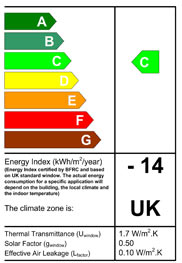 | The u-value method of measuring a window'due south performance has proven to been something of a blunt tool, ignoring, as it does, other factors such as a window'southward capacity to transmit solar free energy. This crudeness of measurement has led, in the last few years, to a system developed by the British Fenestration Rating Quango (world wide web.bfrc.org) that takes into account the multiplicity of factors determining a windows functioning and rates on the basis of a nominal energy balance from A-G. About importantly for the window specifier, information technology encourages manufacturers to publish verifiable information on Ux, g-value and air permeability. Though u-values are notwithstanding often quoted, the BFRC rating system is gaining popularity through its citing by the Edifice Regulations in England and Wales |
Passivhaus certification
Some other useful standard gaining basis is that provided past certification past the Passivhaus Institute. The very high standard requires windows to exist triple glazed and attain u-values of at to the lowest degree 0.viii W/m2C for both the glazing and the frame.
Window technologies
Glazing
'Low-Due east' Drinking glass
• The most pregnant development influencing the market has been that of 'Depression-Due east' drinking glass. By coating the face of the inner pane of drinking glass with metallic or metal oxide, short moving ridge radiation from the sun is permitted to enter the edifice, whilst long wave radiation in the form of oestrus from the inside is reflected back into the room.
• In summertime the coatings can contribute to the gamble of over heating by slightly reducing the amount of short moving ridge radiation transmitted through the glass.
• Because of the restricting upshot of the blanket, Low-Glass will always reduce the glazing'due south G-value.
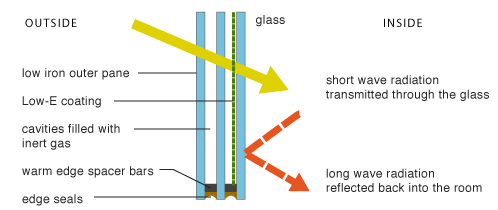
There are two types of Low-E coatings: hard and soft. The difference between them is their method of application, their transmittance and their durability.
Hard (eg Pilkington Chiliad drinking glass): practical during the manufacturing process. Emissivity betwixt 0.fifteen and 2.0
Soft (eg St Gobain Planitherm Total) : applied after manufacture. Emissivity between 0.05 and 0.10. They produce a lower u value. Soft coatings tend to dethrone when exposed to air and wet, are easily damaged, and have a limited shelf life.
Gas filled units
Filling the gap between the drinking glass panes with depression conductivity gas such as argon or krypton (likewise as the more expensive xeon) at atmospheric pressure improves the window functioning by reducing conductive and convective heat transfer. They are mostly used in conjunction with low-emissivity coatings. One drawback though might be the long-term integrity of the fill.
Insulating spacer bars
Multiple glazing units are spaced and sealed by spacer confined around the perimeter of the unit. The traditional material for a spacer bar is aluminium. Only as window standards have become more stringent, the oestrus lost from thermal bridging through the metal has become more than significant. Stainless steel spacer bars are an improvement, but improve performance is to be had through the apply of non-metallic materials such equally steel reinforced polymer, drinking glass fibre or structural foam with, typically, a polysulphide seal. This technology is often referred to every bit 'warm edge'.
• In highly insulated houses, even with warm border spacers, there will be condensation at the lesser border of the pane with double glazing. This is because of convection causing colder argon side by side to the outer pane sinking to the lesser of the unit of measurement (In poorly insulated buildings condensation will be at other points). Triple glazing eliminates this problem because of the two cavities.
Depression iron glass
Removing the iron content from glass increases its light transmittance and therefore its solar gain. Low iron glass is commonly used in the outer pane of multiple-pane units, low-e drinking glass existence used for the inner pane.
Frame design and materials
• Although the window specifier might be handicapped past planning restrictions roofing the materials and advent of replacement windows, window frames must be considered as an important area when because rut loss.
• About energy lost through a frame is through conduction. Technological developments have been dedicated to reducing the overall conductivity through improved materials and the combination of materials to produce 'composite frames'.
• From a 'green' designers point of view, the most important base material is timber. Hardwood frames are preferable and products are bachelor that meet the stringent standards set up by the Passivhaus standard. An alternative is to utilize treated softwood or a wood / aluminium composite where the metallic is used on the external face of the frame – thus significantly improving durability.
• Metal windows have improved through the development of increasingly complex sections, the more recent of which contain thermal breaks.
Windows and the BRE 'Dark-green Guide to Specification'
The Green Guide's arroyo to rating windows is perplexing to many specifiers. Though the guide is correct in identifying the primacy of operation over the environmental touch on of the materials involved, questions continue to be asked about the veracity of the information that supports PVC windows receiving an 'A' rating (on par with softwood), whilst the arguably more than sustainable aluminium / softwood blended windows are awarded a lowly 'D'.
Glazing and condolement
• One of the underlying principles of the Passivhaus standard is that of providing 'thermal comfort' to a building's occupants (for more information near the concept of thermal comfort see www.passivhaustagung.de/Passive_House_E/comfort_passive_house.htm).
• Condolement criteria dictate that the in that location should not be more than 4 K between any surface and air temperature. Exterior of this margin, actress heat is needed to compensate for the increased feeling of discomfort.
• In a building where the walls are well-insulated the temperature deviation between the wall surface and room temperature is minimal, only the temperature differences between glazing and room temperature (bold an indoor room temperature of 21 Yard) can be pregnant according to glazing blazon:
- betwixt single glazing and air temperature tin can be around 20 deg C
- between double glazing and air temperature volition be around 8 deg C
- betwixt triple glazing and air temperature will be around iv deg C (ie within the comfort zone)
Installation
• Windows should exist manufactory-glazed to avoid performance loss associated with site installation.
• Gaps between the frame and the wall should be sealed with low expanding foam backed-up with a single-sided, pre-folded high-performance agglutinative tape (Pro Clima or similar) to provide an airtight bail between the window frame and the wall / vapour control layer.
• Ensure that Low-E glazing is installed the right style around (check the label)
• Check any requirements for rubber glazing.
Farther information
• British Woodworking Federation
• FENSA
• Glass and Glazing Federation
• Council for Aluminium in Edifice
• British Fenestration Rating Council
 Window products on GreenSpec
Disclaimer
GreenSpec accepts no responsibility or liability for any damages or costs of any type arising out of or in any way connected with your employ of this web site. Data and information is provided for information purposes only, and is not intended for trading purposes. Neither GreenSpec nor whatever of its partners shall be liable for any errors in the content, or for any actions taken in reliance thereon.
Source: https://www.greenspec.co.uk/building-design/windows/
Posted by: vanburencongthed.blogspot.com
0 Response to "How Much Heat Comes Through Windows"
Post a Comment